In this post I describe a technique for reducing the allocation associated with calling foreach on an IEnumerable<T>. This has been described and used previously by others, but I was recently optimizing some code in my day job working on the .NET SDK at Datadog and used the technique, so decided to explain it in more detail.
Background: when foreach allocates
foreach is one of the most commonly used patterns in C#; it's literally used all over the place. A quick, crude, search of the dotnet/runtime repository reveals 3.9 thousand instances! The vast majority of those cases are enumerating built-in types from the .NET base class library, such as List<T> and arrays, but you can easily foreach over your own custom types too.
Interestingly, the way that most people likely think or are taught about foreach is that you need to implement IEnumerable (or IEnumerable<T>), and then you can enumerate the collection. This is correct, but there's actually an interesting subtlety. Technically the compiler uses pattern matching, and looks for a GetEnumerator() method that returns an Enumerator-like type with a Current property and MoveNext method. That pattern requirement is the same as what IEnumerable defines, so what's the difference?
Before we dig into that, it's worth taking a look at a quick benchmark which demonstrates the difference.
Creating a benchmark to compare foreach
I started by creating a new BenchmarkDotNet project using their templates by running
dotnet new benchmark
I then updated the Benchmarks file as shown below. This simple benchmark just calls foreach on a List<int> instance, and then runs the same foreach loop on the same List<int>, but this time stored as an IEnumerable<int> variable:
using System.Collections.Generic;
using System.Linq;
using BenchmarkDotNet.Attributes;

[MemoryDiagnoser]
public class Benchmarks
{
    private List<int> _list;
    private IEnumerable<int> _enumerable;

    [GlobalSetup]
    public void GlobalSetup()
    {
        _list = Enumerable.Range(0, 10_000).ToList();
        _enumerable = _list;
    }

    [Benchmark]
    public long List()
    {
        var value = 0;
        foreach (int i in _list)
        {
            value += i;
        }

        return value;
    }

    [Benchmark]
    public long IEnumerable()
    {
        var value = 0;
        foreach (int i in _enumerable)
        {
            value += i;
        }

        return value;
    }
}
You might think that both these benchmarks would give the same results. Afterall, they're running the same foreach loop on the same List<T> instance. The only difference is whether the variable is stored as a List<int> or an IEumerable<int>, that can't make much difference, right?
If we run the benchmarks (I ran them against both .NET Framework and .NET 9), then we can see there actually is a difference; the IEnumerable version is both slower and it allocates:
| Method | Runtime | Mean | Error | StdDev | Allocated |
|---|---|---|---|---|---|
| List | .NET Framework 4.8 | 8.245 us | 0.1582 us | 0.1480 us | - |
| IEnumerable | .NET Framework 4.8 | 25.433 us | 0.4977 us | 0.6644 us | 40 B |
| List | .NET 9.0 | 2.951 us | 0.0587 us | 0.0861 us | - |
| IEnumerable | .NET 9.0 | 8.032 us | 0.1520 us | 0.1422 us | 40 B |
So the question is, why?
foreach as lowered C#
It helps initially to understand exactly what the foreach construct looks like in "lowered" C#. This is effectively what the compiler converts the foreach loop into before converting it to IL. If we take the EnumerateList() method above and run it through sharplab.io, you get the following:
private List<int> _list;

public long EnumerateList()
{
    int num = 0;
    List<int>.Enumerator enumerator = _list.GetEnumerator();
    try
    {
        while (enumerator.MoveNext())
        {
            int current = enumerator.Current;
            num += current;
        }
    }
    finally
    {
        ((IDisposable)enumerator).Dispose();
    }
    return num;
}
As you can see, in this example, the GetEnumerator() method returns a List<int>.Enumerator instance, which exposes a MoveNext() method, a Current property, and implements IDisposable. If we compare that to EnumerateIEnumerable() we get almost the same code:
private IEnumerable<int> _enumerable;

public long EnumerateIEnumerable()
{
    int num = 0;
    IEnumerator<int> enumerator = _enumerable.GetEnumerator();
    try
    {
        while (enumerator.MoveNext())
        {
            int current = enumerator.Current;
            num += current;
        }
    }
    finally
    {
        if (enumerator != null)
        {
            enumerator.Dispose();
        }
    }
    return num;
}
The main difference in the code above is that the GetEnumerator() method returns an IEnumerator<int> instance instead of a concrete List<int>.Enumerator instance. If we look at the implementation details of List<T>'s enumeration methods, we can see there actually 3 different implementations, but they all ultimately delegate to the GetEnumerator() method that returns an List<T>.Enumerator instance.
public class List<T>
{
    public Enumerator GetEnumerator() => new Enumerator(this);
    IEnumerator<T> IEnumerable<T>.GetEnumerator() => GetEnumerator();
    IEnumerator IEnumerable.GetEnumerator() => ((IEnumerable<T>)this).GetEnumerator();

    public struct Enumerator : IEnumerator<T>, IEnumerator
    {
        // details hidden for brevity
    }
}
And importantly, the List<T>.Enumerator is defined as a struct type.
Struct enumerators
The struct enumerator is the key to the difference in allocation. By returning a mutable struct implementation of the Enumerator instead of a class, the List<T>.Enumerator type can be allocated on the stack, avoid any allocation on the heap, and so avoid adding pressure on the garbage collector. That's as long as the compiler can call the GetEnumerator() method directly…
However, when calling foreach on the IEnumerable variable, we need to return an IEnumerator (or IEnumerator<T>) to satisfy the interface. The only way to do that is for the List<T>.Enumerator object to be boxed onto the heap. This is the source of the allocation we saw in the benchmark for the IEnumerable variable.
In general, this limitation is all a little unfortunate and kind of annoying. Returning basic interface types like IEnumerable<T> or ICollection<T> rather than their concrete types is a standard method of encapsulation, which allows for later evolution without disrupting the public API, and is generally, rightly, encouraged. It's just a shame that results in allocation. Unless, that is, you're using .NET 10…
A .NET 10 caveat: deabstraction
If I run the same benchmark above on .NET 10, I get some interesting results:
| Method | Runtime | Mean | Error | StdDev | Allocated |
|---|---|---|---|---|---|
| List | .NET 10.0 | 2.895 us | 0.0527 us | 0.0493 us | - |
| IEnumerable | .NET 10.0 | 3.016 us | 0.0590 us | 0.0725 us | - |
Both benchmarks are essentially the same. There's no allocation, and the execution time is essentially the same! So what's going on here? the short answer is that .NET 10 introduced a bunch of techniques to make this sort of pattern faster. There's devertualization, so the runtime can see that it's always a List<T> and call the struct enumerator, and there's also Object Stack Allocation, where objects which would otherwise be allocated to the heap are actually allocated to the stack if the compiler can prove the object won't "escape". Add to that additional work to fix the List<T>.Enumerator, and you get the glorious results above!
Which is all great if you're using .NET 10. Unfortunately, in my work on the Datadog .NET SDK, we have customers that run on all sorts of older versions of .NET (including .NET Framework), and as we are often in the hot path for apps, we need to be as efficient as possible. And all those 40 byte allocations add up!
Avoiding foreach allocation for known return types
These days, most collection types that are exposed by the BCL or by popular libraries will use the same pattern of a stack-based enumerator. But you lose these performance benefits when the collection is exposed as an IEnumerable collection.
One way to avoid this regression (if you know what the return type of an API will be) is to simply cast to that type, so the compiler can "find" the better GetEnumerator() method:
IEnumerable<int> someCollection = SomeApiThatReturnsAList();

// If we know that someCollection always returns List<T>, we can "help" the compiler
if(someCollection is List<int> list)
{
    // The compiler can call `List<T>.GetEnumerator()`, allocate
    // on the stack, and avoid the boxing allocation
    foreach(var value in list)
    {
    }
}
else
{
    // Optionally Keep a fallback case for safety, in case our assumptions are wrong
    // or it changes in the future
    foreach(var value in someCollection)
    {
    }
}
It feels a bit clumsy but it works to avoid the allocations, and when you're trying to be efficient, every byte counts!
Avoiding foreach allocation when you can't reference the return type
The above approach is easy and works well if
- You know what type is going to be returned by an API. Obviously this may change (that's the whole point of using
IEnumerableafter all!) so you must make sure to handle this scenario. - That type is public, so you can reference it.
That second point is often a problem for us in the Datadog SDK, because we instrument many different libraries, and can't reference them at compile time. So if we want to avoid allocation from enumerators, we need to do something else.
Take for example the Activity.TagObjects property. This API returns an IEnumerable<KeyValuePair<string, object>>, but the concrete type is TagsLinkedList, which is an internal type, with a struct enumerator. We can't use the is trick above because TagsLinkedList isn't public (and we can't use the EnumerateTagObjects() method, because that's not available in all runtimes we support). So how can we avoid the allocation?
The answer was to use an approach that we use in various other places: use Reflection.Emit capabilities to create a DynamicMethod that explicitly uses the struct enumerator.
As I mentioned at the start of this post, this approach isn't novel, and has been described and used previously by others. I mostly took that prior art and tweaked it for my purposes, so kudos to them for doing the hard work!
Designing our Reflection.Emit DynamicMethod
Reflection.Emit refers to the System.Reflection.Emit namespace, which contains various methods for creating new intermediate language (IL) in your application. IL instructions are the "assembly code" that the compiler outputs when you compile your application. The JIT in the .NET runtime converts these IL instructions into real assembly code when your application runs.
Reflection.Emit is primarily used by libraries and frameworks that are either trying to wild things or are trying to eek out performance wherever they can, so it's definitely an "advanced" API. If you haven't used it before, or you find it confusing, don't worry about it!
In the implementation coming below, we're basically going to "manually" construct a method that contains a "lowered" foreach loop, but making sure we call the struct-based GetEnumerator() on the object. Something like this:
// This is effectively the method we're going to create
public static void AllocationFreeForEach(
    TagsLinkedList list, // The object to enumerate
     ref SomeState state, // A state object the callback object can use
      Func<SomeState, KeyValuePair<string, object>, bool> callback) // The callback to execute
{
    // We create a lowered version of this code:
    // foreach(var item in list)
    // {
    //     if (!callback(ref state, item))
    //         break;
    // }
    using (TagsLinkedList.Enumerator enumerator = list.GetEnumerator())
    {
        while (enumerator.MoveNext())
        {
            if (!callback(ref state, enumerator.Current))
                break;
        }
    }
}
We have to create the "lowered" version of the code when constructing our Dynamic Method, which means we also need to lower the using block, so we're actually looking at something more like this instead:
public static void AllocationFreeForEach(
    TagsLinkedList list,
     ref SomeState state,
      Func<SomeState, KeyValuePair<string, object>, bool> callback)
{
    TagsLinkedList.Enumerator enumerator = list.GetEnumerator();

    try
    {
        while (enumerator.MoveNext())
        {
            if (!callback(ref state, enumerator.Current))
                break;
        }

    }
    finally
    {
        enumerator.Dispose();
    }
}
That covers pretty much what we want to emit, all we need to do now is to generate our DynamicMethod.
Generating the DynamicMethod
We'll emit a method similar to the code above, but as a generalized version that can be called with many different enumeration types, and with many different item types.
internal static class AllocationFreeEnumerator<TEnumerable, TItem, TState>
    where TEnumerable : IEnumerable<TItem>
    where TState : struct
{
    // Use reflection to references to the methods we need to call
    private static readonly MethodInfo GenericGetEnumeratorMethod = typeof(IEnumerable<TItem>).GetMethod("GetEnumerator")!;
    private static readonly MethodInfo GenericCurrentGetMethod = typeof(IEnumerator<TItem>).GetProperty("Current")!.GetMethod!;
    private static readonly MethodInfo MoveNextMethod = typeof(IEnumerator).GetMethod("MoveNext")!;
    private static readonly MethodInfo DisposeMethod = typeof(IDisposable).GetMethod("Dispose")!;

    // This is the method we're going to invoke
    public delegate void AllocationFreeForEachDelegate(TEnumerable instance, ref TState state, CallbackDelegate itemCallback);

    // This is the callback which is invoked for each item
    public delegate bool CallbackDelegate(ref TState state, TItem item);

    // Build an allocation-free enumerator
    public static AllocationFreeForEachDelegate BuildAllocationFreeForEachDelegate(Type enumerableType)
    {
        var itemCallbackType = typeof(CallbackDelegate);

        // Try to find a non-interface returning GetEnumerator() method
        var getEnumeratorMethod = ResolveGetEnumeratorMethodForType(enumerableType);
        if (getEnumeratorMethod == null)
        {
            // We couldn't find a non-interface GetEnumerator() method, so
            // fallback to allocation mode and use IEnumerable<TItem>.GetEnumerator
            getEnumeratorMethod = GenericGetEnumeratorMethod;
        }

        var enumeratorType = getEnumeratorMethod.ReturnType;

        // build the Dynamic method (our AllocationFreeForEachDelegate)
        var dynamicMethod = new DynamicMethod(
            "AllocationFreeForEach",
            null,
            [typeof(TEnumerable), typeof(TState).MakeByRefType(), itemCallbackType],
            typeof(AllocationFreeForEachDelegate).Module,
            skipVisibility: true);

        var generator = dynamicMethod.GetILGenerator();

        // TagsLinkedList.Enumerator enumerator
        generator.DeclareLocal(enumeratorType);

        var beginLoopLabel = generator.DefineLabel();
        var processCurrentLabel = generator.DefineLabel();
        var returnLabel = generator.DefineLabel();
        var breakLoopLabel = generator.DefineLabel();

        // enumerator = arg0.GetEnumerator();
        generator.Emit(OpCodes.Ldarg_0);
        generator.Emit(OpCodes.Callvirt, getEnumeratorMethod);
        generator.Emit(OpCodes.Stloc_0);

        // try
        generator.BeginExceptionBlock();
        {
            // while()
            generator.Emit(OpCodes.Br_S, beginLoopLabel);

            generator.MarkLabel(processCurrentLabel);

            // bool shouldContinue = callback(arg1, enumerator.Current);
            generator.Emit(OpCodes.Ldarg_2);
            generator.Emit(OpCodes.Ldarg_1);
            generator.Emit(OpCodes.Ldloca_S, 0);
            generator.Emit(OpCodes.Constrained, enumeratorType);
            generator.Emit(OpCodes.Callvirt, GenericCurrentGetMethod);

            generator.Emit(OpCodes.Callvirt, itemCallbackType.GetMethod("Invoke")!);

            // if (!continue)
            //     break;
            generator.Emit(OpCodes.Brtrue_S, beginLoopLabel);
            generator.Emit(OpCodes.Leave_S, returnLabel);

            // if (enumerator.MoveNext())
            //    goto: start of while loop
            generator.MarkLabel(beginLoopLabel);
            generator.Emit(OpCodes.Ldloca_S, 0);
            generator.Emit(OpCodes.Constrained, enumeratorType);
            generator.Emit(OpCodes.Callvirt, MoveNextMethod);
            generator.Emit(OpCodes.Brtrue_S, processCurrentLabel);

            // close while loop
            generator.MarkLabel(breakLoopLabel);
            generator.Emit(OpCodes.Leave_S, returnLabel);
        }

        // finally
        generator.BeginFinallyBlock();
        {
            // enumerator.Dispose();
            if (typeof(IDisposable).IsAssignableFrom(enumeratorType))
            {
                generator.Emit(OpCodes.Ldloca_S, 0);
                generator.Emit(OpCodes.Constrained, enumeratorType);
                generator.Emit(OpCodes.Callvirt, DisposeMethod);
            }
        }

        generator.EndExceptionBlock();

        generator.MarkLabel(returnLabel);

        // return
        generator.Emit(OpCodes.Ret);

        return (AllocationFreeForEachDelegate)dynamicMethod.CreateDelegate(typeof(AllocationFreeForEachDelegate));
    }

    private static MethodInfo? ResolveGetEnumeratorMethodForType(Type type)
    {
        // Look for a `GetEnumerator()` method that _doesn't_ return an
        // interface. This doesn't _guarantee_ a struct-based enumerator,
        // but it's the standard pattern so catches most cases
        var methods = type.GetMethods(BindingFlags.Instance | BindingFlags.Public | BindingFlags.NonPublic);

        foreach (var method in methods)
        {
            if (method.Name == "GetEnumerator" && !method.ReturnType.IsInterface)
            {
                return method;
            }
        }

        return null;
    }
}
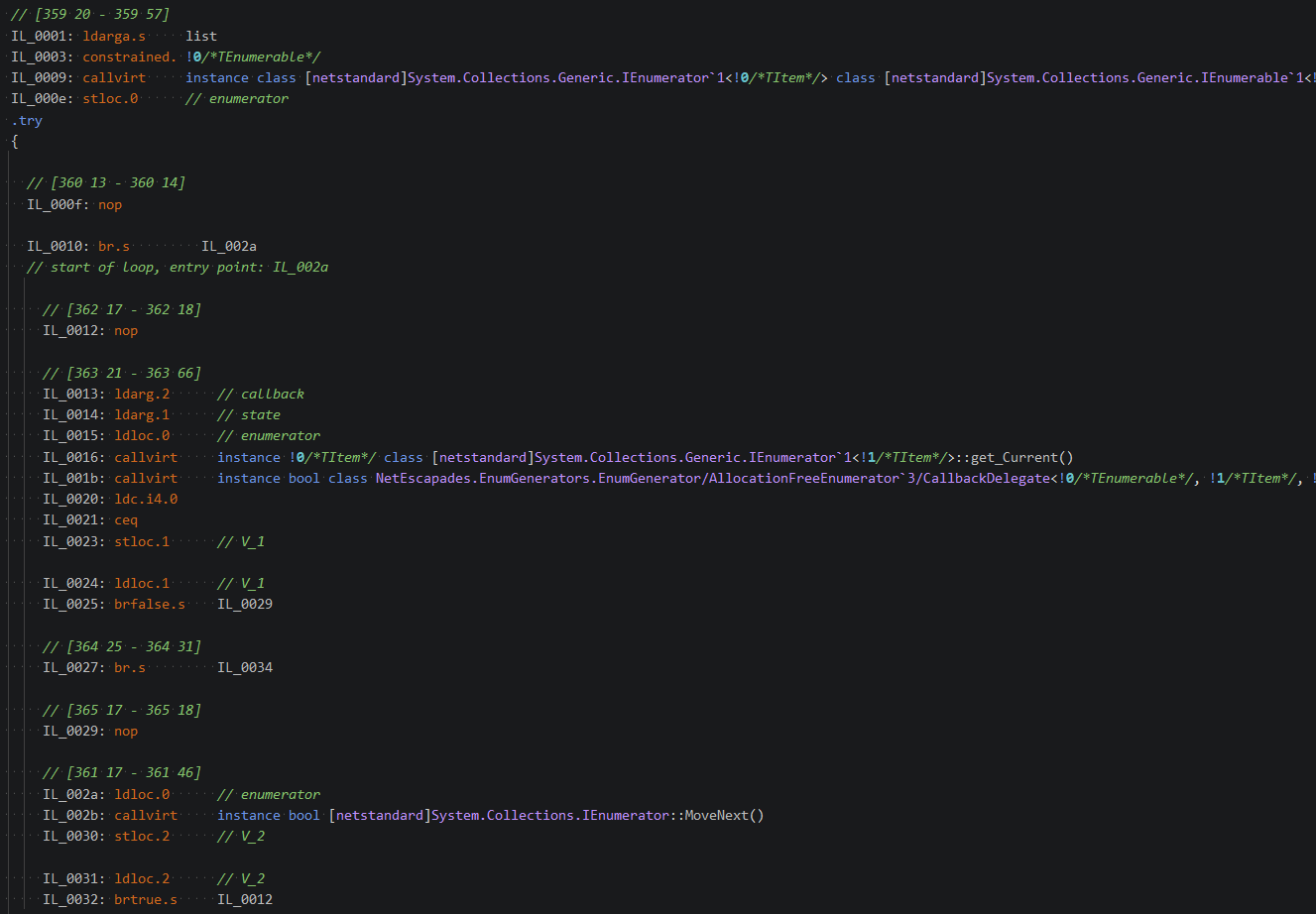
There's a lot of code there, and if you struggle to follow IL then it will no doubt be confusing 😅 The only small piece of advice I have if you're trying to write this code, is to use an IL generator to show the IL that you should be trying to generate. I tend to use the one built into Rider when I'm working on this stuff:
Now that we have this dynamic method generator, we can put it to the test and check the results.
Benchmarking the DynamicMethod on List<T>
To test it out, I initially updated the benchmark to test 3 different scenarios
- A
List<int>saved in aList<int>variable - A
List<int>saved in anIEnumerable<int>variable - A
List<int>saved in anIEnumerable<int>variable, using theDynamicMethodabove
using System;
using System.Collections;
using System.Collections.Generic;
using System.Linq;
using BenchmarkDotNet.Attributes;

[MemoryDiagnoser]
public class Benchmarks
{
    private List<int>? _list;
    private IEnumerable<int>? _listEnumerable;
    private AllocationFreeEnumerator<IEnumerable<int>, int, long>.AllocationFreeForEachDelegate _listEnumerator;

    [GlobalSetup]
    public void GlobalSetup()
    {
        _list = Enumerable.Range(0, 10_000).ToList();
        _listEnumerable = _list;
        _listEnumerator = AllocationFreeEnumerator<IEnumerable<int>, int, long>.BuildAllocationFreeForEachDelegate(_list.GetType());
    }

    [Benchmark]
    public long List()
    {
        long value = 0;
        foreach (int i in _list!)
        {
            value += i;
        }

        return value;
    }

    [Benchmark]
    public long IEnumerable()
    {
        long value = 0;
        foreach (int i in _listEnumerable!)
        {
            value += i;
        }

        return value;
    }

    [Benchmark]
    public long IEnumerableDynamicMethod()
    {
        long value = 0;
        _listEnumerator(_list!, ref value, static (ref state, i) =>
        {
            state += i;
            return true;
        });

        return value;
    }
}
The results from running this against .NET Framework 4.8 and .NET 9 are a bit of a mixed bag:
| Method | Runtime | Mean | Error | StdDev | Allocated |
|---|---|---|---|---|---|
| List | .NET 9.0 | 3.120 us | 0.0573 us | 0.0536 us | - |
| IEnumerable | .NET 9.0 | 7.554 us | 0.0935 us | 0.0828 us | 40 B |
| IEnumerableDynamicMethod | .NET 9.0 | 15.436 us | 0.1631 us | 0.1446 us | - |
| List | .NET Framework 4.8 | 7.789 us | 0.0560 us | 0.0496 us | - |
| IEnumerable | .NET Framework 4.8 | 23.181 us | 0.1515 us | 0.1417 us | 40 B |
| IEnumerableDynamicMethod | .NET Framework 4.8 | 14.894 us | 0.1978 us | 0.1754 us | - |
For .NET Framework, we're clearly onto a winner. We see reduced execution time and we're now allocation-free, so that's great.
For .NET 9, we're now allocation free, but execution time has doubled, which is unfortunate, but likely comes from the fact that List<T> has seen a huge number of performance attention over the years, and we're likely stomping over that somewhat with our DynamicMethod. Whether the performance hit is worth it will likely come down to what the limiting factor is for you here. Bear in mind that the allocation cost is fixed regardless of the size of the list, whereas execution time for this case obviously scales approximately linearly with list size.
For .NET 10, somewhat unsurprisingly, our DynamicMethod approach comes out worse than just using IEnumerable<int>:
| Method | Runtime | Mean | Error | StdDev | Allocated |
|---|---|---|---|---|---|
| List | .NET 10.0 | 3.105 us | 0.0442 us | 0.0413 us | - |
| IEnumerable | .NET 10.0 | 3.162 us | 0.0365 us | 0.0341 us | - |
| IEnumerableDynamicMethod | .NET 10.0 | 15.448 us | 0.2034 us | 0.1903 us | - |
This is what we'd expect, given all the performance improvements over the years, and the attention that's been given to List<T>. Given that enumerating IEnumerable<T> is already allocation free in .NET 10, there's no good reason to use it in this case.
Benchmarking the DynamicMethod with a custom IEnumerable<T>
My initial reason for looking into the DynamicMethod approach was for handling types that aren't built into the BCL, so I took a look at benchmarking a custom IEnumerable<T> implementation. The following linked list implementation is super basic, and is a heavily stripped-down version of an implementation used internally by Activity. These details aren't really important, I just include it below for completeness:
internal sealed class CustomLinkedList<T> : IEnumerable<T>
{
    private Node<T>? _first;
    private Node<T>? _last;

    public CustomLinkedList()
    {
    }

    public CustomLinkedList(T firstValue) => _last = _first = new Node<T>(firstValue);

    public CustomLinkedList(IEnumerator<T> e)
    {
        _last = _first = new Node<T>(e.Current);

        while (e.MoveNext())
        {
            _last.Next = new Node<T>(e.Current);
            _last = _last.Next;
        }
    }

    public Node<T>? First => _first;

    public void Add(T value)
    {
        Node<T> newNode = new Node<T>(value);
        if (_first is null)
        {
            _first = _last = newNode;
            return;
        }

        _last!.Next = newNode;
        _last = newNode;
    }

    public Enumerator<T> GetEnumerator() => new Enumerator<T>(_first);
    IEnumerator<T> IEnumerable<T>.GetEnumerator() => GetEnumerator();
    IEnumerator IEnumerable.GetEnumerator() => GetEnumerator();


    internal struct Enumerator<T> : IEnumerator<T>
    {
        private static readonly Node<T> s_Empty = new Node<T>(default!);

        private Node<T>? _nextNode;
        private Node<T> _currentNode;

        public Enumerator(Node<T>? head)
        {
            _nextNode = head;
            _currentNode = s_Empty;
        }

        public T Current => _currentNode.Value;

        object? IEnumerator.Current => Current;

        public bool MoveNext()
        {
            if (_nextNode == null)
            {
                _currentNode = s_Empty;
                return false;
            }

            _currentNode = _nextNode;
            _nextNode = _nextNode.Next;
            return true;
        }

        public void Reset() => throw new Exception();

        public void Dispose()
        {
        }
    }

    internal sealed partial class Node<T>
    {
        public Node(T value) => Value = value;
        public T Value;
        public Node<T>? Next;
    }
}
I then updated the benchmark to run the same set of tests with the CustomLinkedList implementation instead:
using System;
using System.Collections;
using System.Collections.Generic;
using System.Linq;
using BenchmarkDotNet.Attributes;

[MemoryDiagnoser]
public class Benchmarks
{
    private CustomLinkedList<int>? _linkedList;
    private IEnumerable<int>? _linkedListEnumerable;
    private AllocationFreeEnumerator<IEnumerable<int>, int, long>.AllocationFreeForEachDelegate _linkedListEnumerator;

    [GlobalSetup]
    public void GlobalSetup()
    {
        _linkedList = new();
        foreach (var i in Enumerable.Range(0, 10_000))
        {
            _linkedList.Add(i);
        }

        _linkedListEnumerable = _linkedList;
        _linkedListEnumerator =
            AllocationFreeEnumerator<IEnumerable<int>, int, long>.BuildAllocationFreeForEachDelegate(
                _linkedList.GetType());
    }

    [Benchmark]
    public long LinkedList()
    {
        long value = 0;
        foreach (int i in _linkedList!)
        {
            value += i;
        }

        return value;
    }

    [Benchmark]
    public long IEnumerableLinkedList()
    {
        long value = 0;
        foreach (int i in _linkedListEnumerable!)
        {
            value += i;
        }

        return value;
    }

    [Benchmark]
    public long IEnumerableLinkedListDynamicMethod()
    {
        long value = 0;
        _linkedListEnumerator(_linkedList!, ref value, static (ref state, i) =>
        {
            state += i;
            return true;
        });

        return value;
    }
}
The results from these CustomLinkedList<T> benchmarks are pretty similar to the ones for List<T>, but with one main caveat: the DynamicMethod approach is now faster on .NET 9 as well as not allocating, so it becomes a clear winner in this case. The speed up for .NET Framework is also quite substantial:
| Method | Runtime | Mean | Error | StdDev | Allocated |
|---|---|---|---|---|---|
| LinkedList | .NET 9.0 | 7.844 us | 0.1340 us | 0.1254 us | - |
| IEnumerableLinkedList | .NET 9.0 | 18.892 us | 0.3430 us | 0.3209 us | 32 B |
| IEnumerableLinkedListDynamicMethod | .NET 9.0 | 15.148 us | 0.2613 us | 0.2445 us | - |
| LinkedList | .NET Framework 4.8 | 7.914 us | 0.1295 us | 0.1212 us | - |
| IEnumerableLinkedList | .NET Framework 4.8 | 42.272 us | 0.8344 us | 0.9933 us | 32 B |
| IEnumerableLinkedListDynamicMethod | .NET Framework 4.8 | 13.480 us | 0.2430 us | 0.2273 us | - |
As before, with .NET 10, the results for the DynamicMethod are worse than the plain IEnumerable<<T>. This is actually really quite impressive—.NET 10 manages to treat the LinkedList and IEnumerableLinkedList benchmarks as essentially indistinguishable. Very cool 😎
| Method | Runtime | Mean | Error | StdDev | Allocated |
|---|---|---|---|---|---|
| LinkedList | .NET 10.0 | 7.944 us | 0.1570 us | 0.1542 us | - |
| IEnumerableLinkedList | .NET 10.0 | 7.798 us | 0.0745 us | 0.0622 us | - |
| IEnumerableLinkedListDynamicMethod | .NET 10.0 | 14.990 us | 0.2606 us | 0.2559 us | - |
So there you have it—a way to do allocation free enumeration of collection types. Obviously the question of whether you should do this is entirely context-dependent. If the enumeration is in a hot path, you're not on .NET 10, and these allocations are showing up in your profiling, then, well, maybe you should consider it 😅
Summary
In the first part of this post I provide some background on how and when a foreach loop might cause allocations. I create a simple benchmark to demonstrate the problem, show the "lowered" C#, and describe that the allocation comes from boxing a struct enumerator.
In the second part of the post, I describe how you can avoid this allocation, for scenarios where you can't simply cast to a known type, by creating a DynamicMethod using Reflection.Emit. This is a pretty advanced technique, but it shows how you can completely remove the allocations from enumeration.
Finally, I showed how this approach performs in benchmarks. If you're using .NET 10, then you have no need for the DynamicMethod and don't need to worry at all 😀 On earlier runtimes, including .NET Framework, the DynamicMethod approach eliminates allocations, and in many cases improves execution time, particularly for "custom" collection types.
Whether you should use this approach is very context dependent. In most scenarios, allocating 40 bytes is not a big deal. But if it is a problem for you, now you have a tool in your toolbelt!