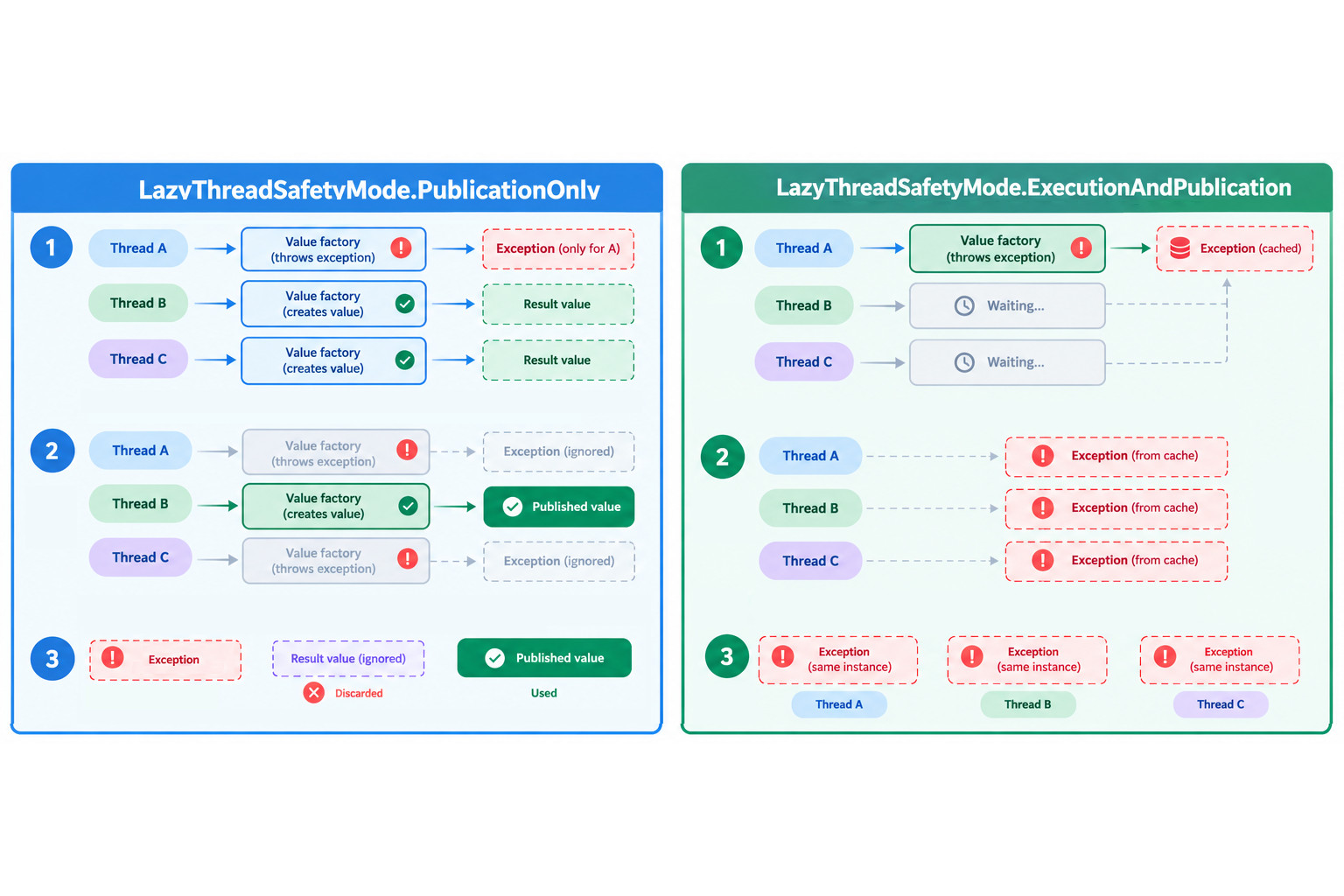

In this post I look at the various thread-safety modes available for the venerable Lazy<T> type. This type has been around for a long time, but I recently saw some people (understandably) confused about the interactions between LazyThreadSafetyMode and exceptions, so this post aims to demonstrate how they work.
What is Lazy<T> For?
The Lazy<T> type has been around since .NET Framework 4.0 (and .NET Core 1.0). It provides is a way to describe how an object should be created, while deferring the actual creation to later. In other words, the object is lazily initialized. In one of it's simplest form, it might look like this:
// You provide a function that should be invoked when the object is required.
Lazy<object> lazy = new(Create);

// The `Create` factory method is not invoked (and the object is not created) until
// you access the `Value` property on the Lazy<T>
var obj = lazy.Value;

// A factory method
object Create()
{
    // This would normally do something expensive or with side effects
    return new object();
}
There are various other forms, not all of which use a factory method, but I have found the factory mode to be the most commonly used, so it's the only version I look at in this post.
Lazy<T> is useful wherever you want to delay or control the creation of the target object, T. This is often because T is expensive to create, and so you don't want to create it until you need it. Lazy<T> also provides a way to tune the behaviour when multiple threads try to access the Value property. This behaviour is controlled by the LazyThreadSafetyMode in the constructor.
In addition to overloads that take
LazyThreadSafetyMode, there are also overloads that take anisThreadSafeboolean value. I won't be looking at those overloads.
Choosing a LazyThreadSafetyMode
There are three different thread-safety modes you can use with Lazy<T>. In brief, these are:
None. TheLazy<T>object provides no thread-safety, and is not safe to be called from more than one thread.PublicationOnly. Multiple threads can run the factory method at once, but "publishing" the finalValueis thread-safe, so only one of the threads can "win".ExecutionAndPublication. Only one thread will run the factory, and publish it's value for all the other threads to see.
We'll look at each of these cases in more detail below.
Use None when you have a single thread
The None case is a simple one because it just avoids the whole threading/concurrency issue entirely. It is not safe to call a Lazy<T> that was created with LazyThreadSafetyMode.None from multiple threads, so if there's any chance of that in your application None is not for you! Attempting to do so will likely lead to InvalidOperationExceptions being thrown.
Thanks to this limitation, LazyThreadSafetyMode.None only really makes sense as a way to delay running a function until later and caching the result. And in that scenario, a simple use of ??= might be conceptually simpler, depending on your code (or use LazyInitializer, as I describe later).
For example, the following are somewhat equivalent:
// The Lazy is provided the Create factory method
private readonly Lazy<object> _lazy = new(Create, LazyThreadSafetyMode.None);

// To do something with the lazy you always need to call .Value
// and the value is created the first time it's accessed
public void SomeMethod()
{
    var myValue = _lazy.Value;
    // .. do something with value
}
and
// The field is nullable, not readonly, and not initialized
private object? _value;

// Make sure that you initialize the value the first time it's accessed
// Using a property ensures the value is always initialized the first time it's used.
private object Value => _value ??= Create();

public void SomeMethod()
{
    var myValue = Value;
    // .. do something with value
}
Given we've already said this code is single-threaded, the Lazy<T> with None doesn't add a lot of extra value over a simple nullable field, though arguably it does better capture intent.
Racing for completion with PublicationOnly
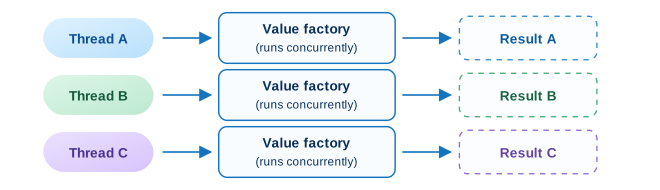
We'll now move on to looking at modes which are intended to be thread-safe and accessed concurrently. When you create a Lazy<T> with LazyThreadSafetyMode.PublicationOnly, and then multiple threads try to access the Value property:
- Multiple threads start running the factory method independently.
- Whichever thread finishes first "wins", and its return value is "published" to the
Valueproperty. - When the other threads finish running the factory methods, their values are discarded, and all of the threads instead receive the previously published value.
- Any threads that try to access
Valueafter the value is published receive the published value immediately, without running the factory function.
The following diagrams show an example of this process. All the threads that call Value before a value is published run the factory method concurrently:
Whichever thread finishes first sets the Lazy<T>.Value:
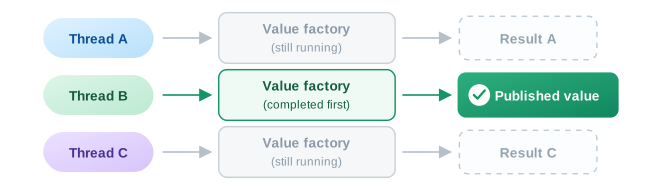
When the other threads finish, their values are ignored, and they all get the same published value.

So all the threads see the same value, even though the factory method may run more than once, and generate more than one value.
Once-only initialization with ExecutionAndPublication
The other thread-safe mode is ExecutionAndPublication. When you create a Lazy<T> with LazyThreadSafetyMode.ExecutionAndPublication, and then multiple threads try to access the Value property:
- Only the first thread to try to access
Valueruns the factory method. - All the other threads are blocked waiting for the first thread to finish.
- Once the first thread finishes, it publishes the value, and returns it to the other threads.
The following diagrams show an example of this process. Only the first thread that calls Value before a value is published runs the factory method, all others block waiting:
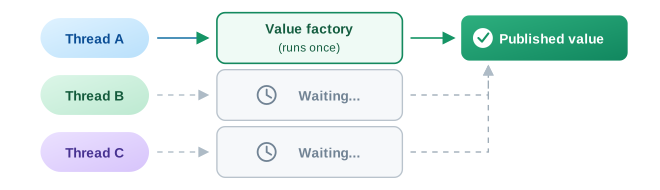
Once the thread finishes, it's passed to all the other blocked threads
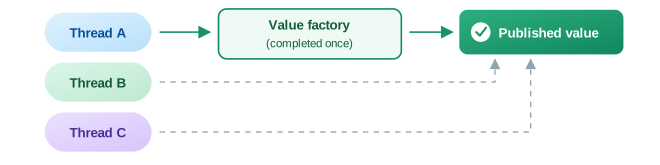
The factory only runs once, and a single value is published.
In most cases, in my experience, the run-once behaviour of ExecutionAndPublication is often what you want from Lazy<T> but that's not always the case.
Choosing between PublicationOnly and ExecutionAndPublication
The big advantage of ExecutionAndPublication is that it only runs the factory once. If you are using Lazy<T> as a way to avoid duplicating expensive initialization, or to gate access to some resources, then ExecutionAndPublication achieves this where PublicationOnly does not. ExecutionAndPublication also avoids you creating multiple return objects and then discarding some of them, so if the created object is large, ExecutionAndPublication can avoid the extra allocations.
There are some cases, however, where PublicationOnly might be faster due to avoiding the extra synchronisation mechanisms that are required by ExecutionAndPublication. If running the factory method (and creating the return object) is cheap, then using PublicationOnly and running multiple instances of the factory can sometimes be cheaper than serializing with a lock. For example, if
- There is heavy concurrent access during initialisation.
- The factory executes quickly.
- Running the factory more than once is safe.
- Duplicate allocations are cheap.
- Lock contention is significant.
Then PublicationOnly might be a better choice than ExecutionAndPublication.
There's one other critical difference between how PublicationOnly and ExecutionAndPublication work, and that's how they handle exceptions.
Understanding exceptions with LazyThreadSafetyMode
Lazy<T> has two different possible behaviours when it comes to a factory method that throws exceptions
- Cached: in this case a factory throwing an exception is "cached" the same way a "success" result is; subsequent calls to
Valuethrow the exception again each time. - Uncached: in this case, exceptions are thrown to the caller, but a subsequent/concurrent call will not automatically get the same exception thrown.
Whether exceptions are cached or not depends entirely on the LazyThreadSafetyMode:
| Mode | Exceptions cached? |
|---|---|
| None | Yes |
| PublicationOnly | No |
| ExecutionAndPublication | Yes |
As you can see, PublicationOnly is the only scenario where exceptions are not cached. The following exceptions demonstrate that more clearly.
ExecutionAndPublication caches exceptions
As you've already seen, ExecutionAndPublication only runs the factory method on a single thread. If that factory throws an exception, the exception is cached:
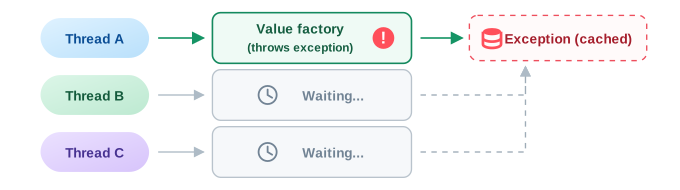
All concurrent threads, and any subsequent callers of Value all have the cached exception thrown:
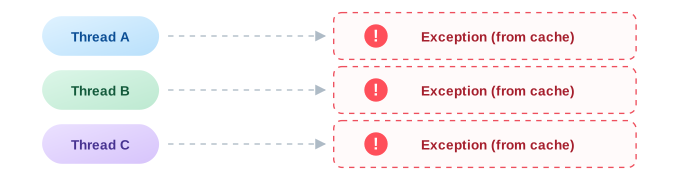
Every caller sees the same Exception instance in each case. At this point, the Lazy<T> is effectively "broken"; it will never return a "real" value. The None case works the same way (it just doesn't support concurrent access).
PublicationOnly does not cache exceptions
For PublicationOnly, when a value is not yet published to Value, the factory method runs on multiple threads. If the factory method for a given thread, say thread A, throws an exception, then that thread will see the exception, but it does not propagate to other threads, and it is not cached:
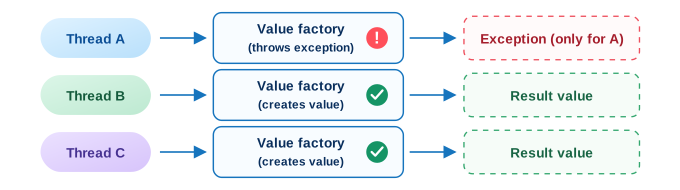
Any of the threads that throw an exception from their factory methods will bubble up that exception, The first thread that successfully executes the factory publishes its value
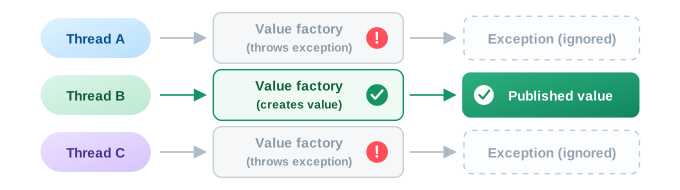
Any threads that are currently running, and which subsequently complete after a value has been published will have their result discarded and replaced with the published value. Any of the currently running threads that throw an exception will still see that exception, even after the successful results is published; exceptions are not swallowed

Once a value has been successfully published, then any subsequent threads that call Value will always see this value; they won't run the factory method, and so won't throw.
Changes (maybe) coming in .NET 12
The fact that exception caching is tied to the thread-safety behaviour, despite being orthogonal behaviour, is something of a wart on the API.
There has been a proposal raised on the .NET runtime for 8 years to add a new mode that allows an ExecutionAndPublication mode that does not cache exceptions. This was subsequently updated to simply be a bool cacheExceptions flag, so that you can have the full range of behaviours.
The good news is that this proposal was recently approved.🎉 It's not implemented yet, but hopefully in .NET 12 you'll be able to disconnect these two aspects so that you can, for example, use ExecutionAndPublication without having exceptions cached.
Alternative approaches with LazyInitializer
This post is primarily about Lazy<T>, but there's another approach you can use that gives you behaviour similar to the ExecutionAndPublication mode, which doesn't require allocating a Lazy<T> object at all, LazyInitializer.EnsureInitialized<T>().
There are several ways to use LazyInitializer, but the example below shows how you can get either PublicationOnly or ExecutionAndPublication-like behaviour, depending on what you want, without a dedicated Lazy<T> object.
The PublicationOnly version looks like this:
// The field that will be lazy-initiatized
private object? _value;

// LazyInitializer ensures the ref field is initialized if it
// hasn't been already, and is then returned. This overload
// works similarly to PublicationOnly, in that threads race to
// create and publish the value.
var value = LazyInitializer.EnsureInitialized(ref _value, Create);
while the ExecutionAndPublication version takes an additional field as a lock:
// The field that will be lazy-initiatized
private object? _value;
// The value to use as a lock
private object? _lock;

// LazyInitializer ensures the ref field is initialized if it hasn't
// been already using the _lock (initializing it first) to ensure the
// factory only runs once, and then returns the value. This overload
// works similarly to ExecutionAndPublication, in that the Create
// factory only ever runs once.
var value = LazyInitializer.EnsureInitialized(ref _value, ref _synclock, Create);
One big difference compared to the Lazy<T> equivalent is that neither of these approaches catch or cache exceptions.
Whether you should reach for Lazy<T> or LazyInitializer depends on what you're trying to achieve. If you want to pass lazily-initialized values around, then Lazy<T> is the obvious choice. On the other hand, using LazyInitializer can potentially avoid an additional object allocation, and in the case where you just need a simple field initialization, may be simpler.
Summary
In this post, I described the different thread-safety modes of the Lazy<T> type. None is not thread-safe, so must not be used where there are multiple threads. With PublicationOnly, multiple threads "race" to create the value, but they all see the result from whichever thread wins. With ExecutionAndPublication, only one thread runs the factory method, and then all threads see the value. For None and ExecutionAndPublication, any exceptions are cached, and will be thrown on subsequent accesses. For PublicationOnly, exceptions are not cached.